
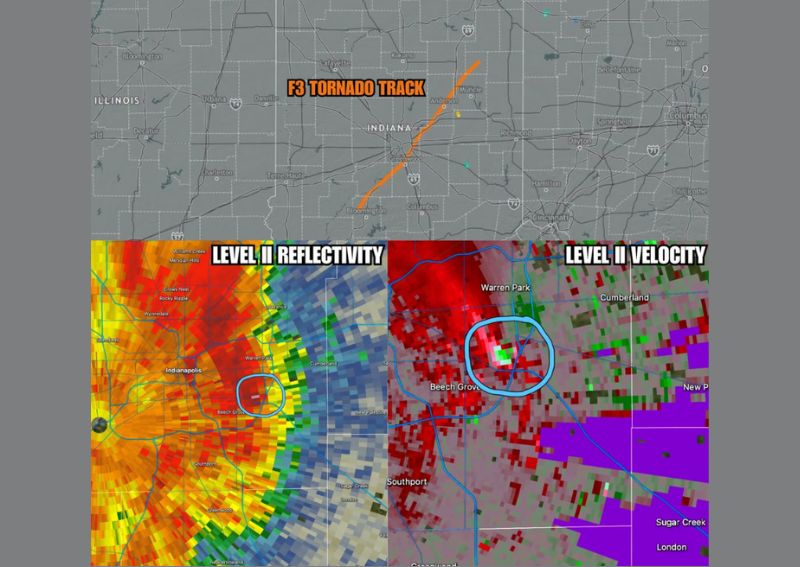
INDIANAPOLIS, IN — Twenty-four years ago on September 20, 2002, an F3 tornado carved a path across central Indiana that still holds the record today for the longest tornado track in state history. The powerful tornado was part of a larger outbreak that produced a total of nine tornadoes across the region that day, with radar imagery capturing the storm’s destructive path as it moved through Johnson and Marion Counties during the afternoon hours.
Tornado Emergency Issued for Two Counties
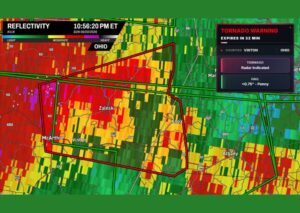
At the height of the event, a rare Tornado Emergency was issued specifically for northern Johnson County and Marion County, signaling to forecasters and emergency officials that a confirmed, significant tornado was on the ground and posing an imminent threat to life. Radar data from 1:52 PM Eastern Time on the day of the event shows the tornado’s circulation clearly visible near the Beech Grove and Southport areas south of downtown Indianapolis.
Radar Imagery Captured the Storm’s Intensity
Level II reflectivity and velocity radar scans from that afternoon reveal the hallmarks of a significant tornadic supercell, with a distinct hook-shaped signature visible on reflectivity imagery near Indianapolis and Beech Grove. The corresponding velocity data shows a tight, well-defined couplet of extreme inbound and outbound wind values, a radar signature meteorologists use to confirm the presence of intense rotation associated with a tornado on the ground.
Longest Tornado Track in Indiana History
The F3 tornado’s path stretched an extraordinary distance across the state, extending from near Bloomington in the southwest through Johnson and Marion Counties before continuing northeast toward the Muncie area. This extended track remains the longest ever recorded for a single tornado in Indiana, a distinction that has held for more than two decades despite numerous subsequent severe weather events across the state.
Remarkable Outcome Despite the Storm’s Power
Despite the tornado’s significant strength and the record-setting length of its track, the event resulted in zero fatalities, though 130 injuries were reported in connection with the broader outbreak of nine tornadoes that day. This outcome underscores the importance of the warning systems and public awareness efforts that were in place at the time, even as the storm’s physical impact left a lasting mark on Indiana’s severe weather history.
For continuing coverage of severe weather events and critical storm analysis across the United States, visit diamondprowl.com.