

DALLAS-FORT WORTH, TX — It’s official: the 67-day drought at DFW International Airport has come to an end after the airport recorded measurable rainfall this evening, marking the conclusion of the second longest rain-free stretch in the location’s recorded history. The extended dry period had persisted for more than two months without a single measurable rainfall reading at the airport, one of the primary official reporting stations for the entire Dallas-Fort Worth metroplex.
A Historic Stretch Without Rain Comes to a Close
The 67-day streak without measurable precipitation at DFW Airport represented the second longest such stretch on record for the location, underscoring just how significant and prolonged this particular dry spell had become before finally breaking this evening. Measurable rainfall, defined as any accumulation of at least 0.01 inches, had eluded the airport’s official rain gauge for more than nine consecutive weeks, a remarkable stretch given the region’s typical precipitation patterns throughout the late summer and early fall months.
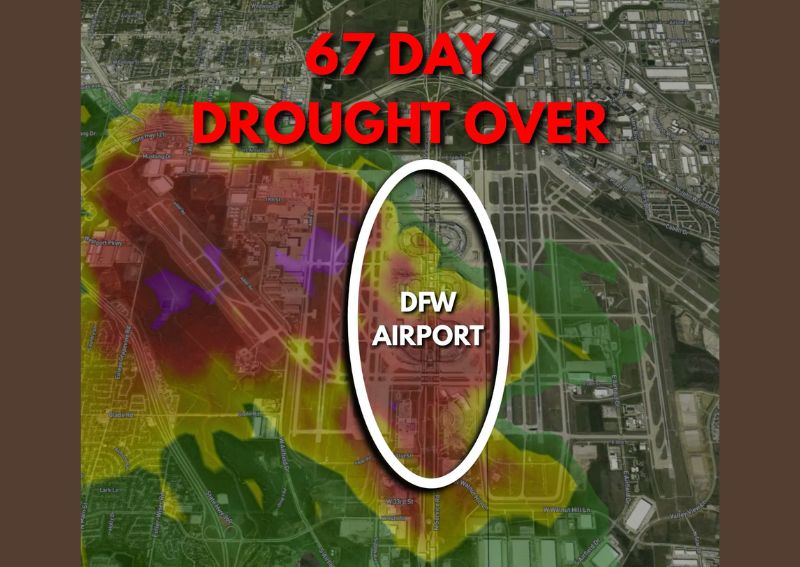
Radar and satellite imagery from this evening show rainfall finally developing directly over the DFW Airport property, with the precipitation shield extending across a broad portion of the surrounding metroplex as the long-awaited system moved through the region. The arrival of this rain, even in modest amounts, carries outsized significance given the extraordinary length of the preceding dry stretch.
Extreme Drought Conditions Persist Despite the Rain
While the end of the 67-day rain-free streak represents a notable and welcome development, meteorologists are careful to emphasize that the broader drought conditions affecting the Dallas-Fort Worth region remain firmly in place. A single rainfall event, however overdue, does not erase the cumulative precipitation deficit that has built up over more than two months without measurable rain, and the region continues to sit within an extreme drought classification according to current monitoring.
Breaking a lengthy dry streak is often an important psychological and meteorological milestone, but forecasters caution that sustained relief for the region’s soil moisture, reservoir levels, and overall drought status will require considerably more rainfall over an extended period before conditions can be considered meaningfully improved.
Second Longest Dry Streak in Recorded History
The significance of this particular drought stretch is underscored by its ranking as the second longest rain-free period ever recorded at DFW Airport, a station with decades of historical data available for comparison. Only one previous stretch in the airport’s recorded history exceeded the 67 days without measurable rainfall that just concluded, placing this event among the more remarkable weather milestones the region has experienced in recent memory.
This kind of extended dry period can have significant cascading effects across a region, from stressed vegetation and elevated wildfire risk to strain on water resources, making the length and severity of this particular streak a notable data point for understanding the broader climate patterns affecting North Texas this year.
What Comes Next for the Region
With the immediate rain-free streak now broken, attention turns to whether this evening’s rainfall represents an isolated event or the beginning of a more sustained pattern change capable of chipping away at the extreme drought conditions still gripping the region. Meteorologists will continue monitoring both the immediate forecast for additional rainfall opportunities and the longer-term outlook for the Dallas-Fort Worth area as the drought situation continues to evolve.
Residents across the metroplex, many of whom have watched the dry streak stretch on for more than two months, will be looking for continued rainfall in the days and weeks ahead as the region works to recover from what has already been classified as one of the most significant dry periods in the area’s recorded weather history.
Local meteorologists have indicated they will continue tracking rainfall totals and drought monitor updates closely in the coming weeks, providing residents with ongoing assessments of how much additional precipitation the region will need before the current extreme drought classification can realistically be downgraded. For now, the end of the 67-day streak stands as a small but meaningful milestone in what remains an otherwise challenging stretch for North Texas.
The broader significance of this event extends beyond a single rain gauge reading at one airport, as DFW Airport’s official measurements are widely used as a benchmark for tracking precipitation trends across the entire Dallas-Fort Worth region, meaning today’s rainfall likely reflects at least some improvement in conditions across a much wider footprint than the airport property itself.
For continuing coverage of severe weather events and critical storm analysis across the United States, visit diamondprowl.com.