
TROY, NY — Families in Troy are still delivering babies at the Burdett Birth Center after a broad community campaign persuaded Trinity Health to reverse plans to close the facility. The birthing center at Samaritan Hospital had been considered at risk when the health system said it was losing money and needed to consolidate services.
What followed was an unusual local effort that brought together Republicans and Democrats, hospital staff, patient advocates, mothers, midwives, doulas and faith leaders. In the end, the fight to preserve the center became a story not only about childbirth care, but about how a city rallied around a service many residents saw as essential to daily life.
A birthing center many families saw as central to Troy life
Burdett Birth Center had served Troy families for generations at Samaritan Hospital on a hill above the city. In recent years, it developed a reputation for patient-centered maternity care, with midwives and doulas working alongside obstetricians.
That model appealed to mothers who wanted to avoid unnecessary C-sections and to give birth close to home. Hospital data from 2025 showed that about a quarter of births at Burdett were delivered by C-section, compared with about a third statewide. The center also reported fewer preterm births and fewer babies with low birth weights.
For local parent Lidia Zambrano-Madera, the choice was personal as well as practical. She said she gave birth to both of her children at Burdett with a midwife and would not have wanted to go anywhere else.
Trinity Health said the center was losing money
Three years ago, Trinity Health said the birth center could not sustain itself financially and announced it would close. The Michigan-based system said Troy families and others in Rensselaer County would need to deliver at another Trinity hospital in Albany, about a half-hour away.
Steven Hanks, who oversees Trinity hospitals in New York and New England, said the company had been trying to limit how much care it spread across its network. He said healthcare systems eventually face hard choices about which services they can continue to support.
The hospitals in the region operate under the St. Peter’s Health Partners brand. For many residents, though, the announcement felt abrupt and deeply disruptive, especially because it would have forced pregnant patients to travel farther for care at a vulnerable time.
Residents organized quickly after the closure plan became public
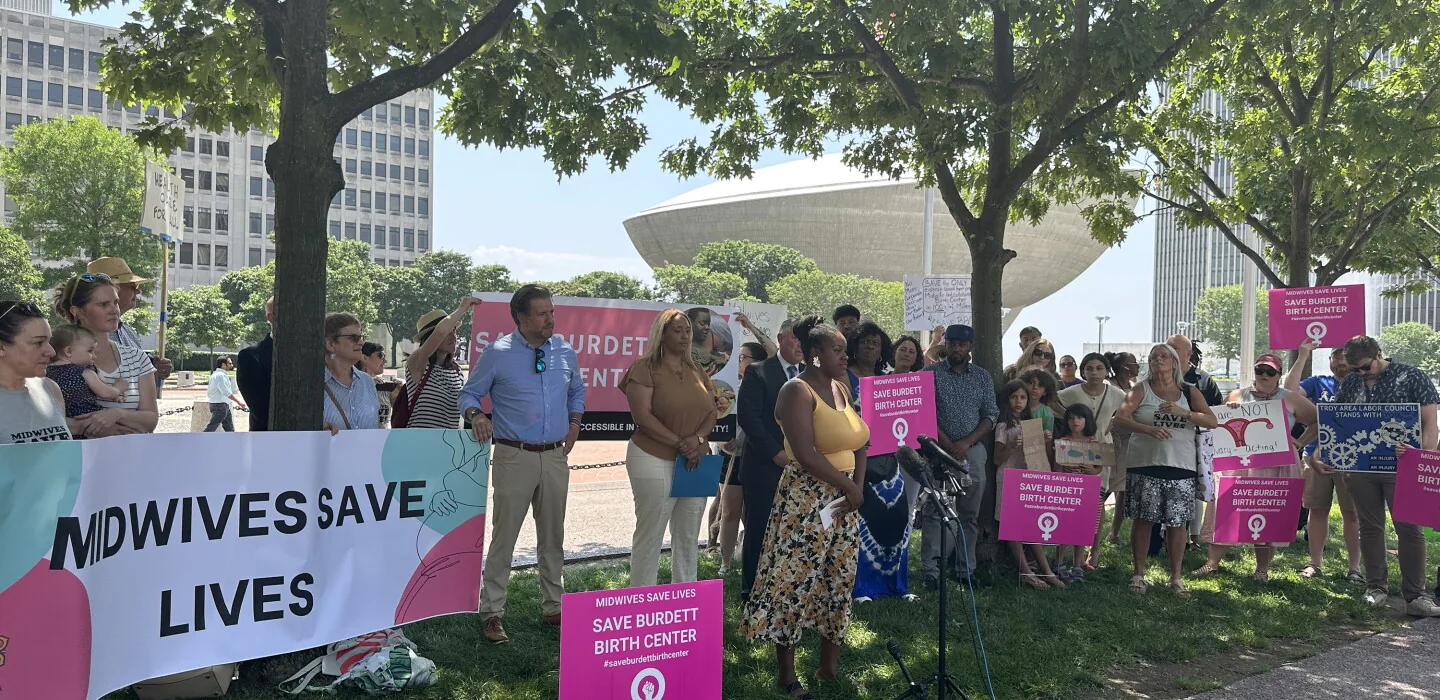
News of the planned shutdown triggered a fast and emotional response in Troy. Community leaders, midwives, mothers and elected officials held rallies, including one at the YWCA in downtown Troy, and volunteers began handing out pink “Save Burdett” signs.
Supporters also made T-shirts and spread the message at the local farmers market. The campaign drew energy from residents who felt the hospital had not fully considered how the closure would affect working families and low-income patients.
A community survey found that 1 in 4 Troy residents did not have access to a car, raising concerns about how they would reach Albany for labor and delivery care. Organizers said that made the birthing center not just convenient, but necessary.
A rare alliance formed across party lines and faith communities
The effort to save Burdett brought together people who often disagree on politics. Troy’s Republican mayor, Carmella Mantello, said the issue united residents regardless of party affiliation or whether they voted at all.
Even the local Catholic bishop objected to the closure plan, saying it conflicted with the mission of Catholic healthcare to support life and those who bring it into the world. The campaign also drew support from Planned Parenthood, creating an unlikely alliance around a single hospital service.
Jessica Hayek, a doula and birth educator who helped lead the push, said many residents were reacting to what they saw as a distant corporation making decisions from far away. She argued that a local birth center was worth more than a balance-sheet calculation.
State pressure and public scrutiny helped change Trinity’s position
As opposition grew, state officials stepped in. New York Attorney General Letitia James launched an investigation into the proposed closure and held a daylong hearing in Troy.
State Assembly member John T. McDonald III, who represents Troy, worked with Republican county and state officials to secure $5 million in state funding that helped support the effort to keep Burdett open. McDonald said the collaboration showed what can happen when elected leaders listen to the public.
Trinity Health had also sued the state as it pushed forward with the closure plan, but after nearly a year of sustained pressure, the company reversed course. Burdett Birth Center remained open, giving Troy families a result they had been afraid they would lose.
Troy’s outcome reflects a broader debate over corporate healthcare
Observers say the Troy fight fits a larger pattern of Americans growing wary of hospital consolidation. Lois Uttley, a New York City-based researcher and activist who has worked with communities facing closures, said big health systems often promise better quality and lower costs, but communities do not always see those benefits delivered.
She said hospitals across the country have been closing or scaling back services, and that trend is making residents more skeptical of corporate healthcare decisions. In Troy, that skepticism crossed political lines and helped unite people who might not otherwise have worked together.
For McDonald, the lesson was practical as well as symbolic. He said the city’s experience showed that progress is possible when people set aside their differences and work toward a shared goal, especially when a critical community service is at stake.