


TRAVERSE CITY, MI — A military pilot safely ejected before an F-16 fighter jet crashed Thursday in rural Grand Traverse County, sending smoke into the air and leading officials to ask nearby residents to shelter in place. Police later expanded the response to a one-mile evacuation zone after saying hazardous chemicals had spilled from the wreckage.
The pilot was taken to a local hospital and was conscious and speaking with law enforcement there, Grand Traverse County Sheriff Michael D. Shea said. Military officials said the crash is under investigation, and they have not released the pilot’s identity or specific injuries.
Training flight ends in crash near northern Michigan
The jet was taking part in training exercises connected to a National Guard base in Alpena, about 190 miles north of Detroit. Sgt. Derek Gutierrez, a public affairs specialist with the 149th Fighter Wing at Joint Base San Antonio-Lackland in Texas, said the aircraft was one of several F-16s participating in the Michigan exercises.
Gutierrez said he had not heard confirmation of a bird strike, even though another pilot later told air traffic controllers he believed his wingman may have hit a bird. Audio posted by liveatc.net captured the other pilot reporting a possible Mayday and saying his wingman had already crashed.
The controller tried to direct him to nearby airports in Frankfort or Traverse City, but the pilot said the other aircraft was already down. Officials said the cause of the crash remains under investigation.
Smoke, explosions and debris alarmed residents nearby
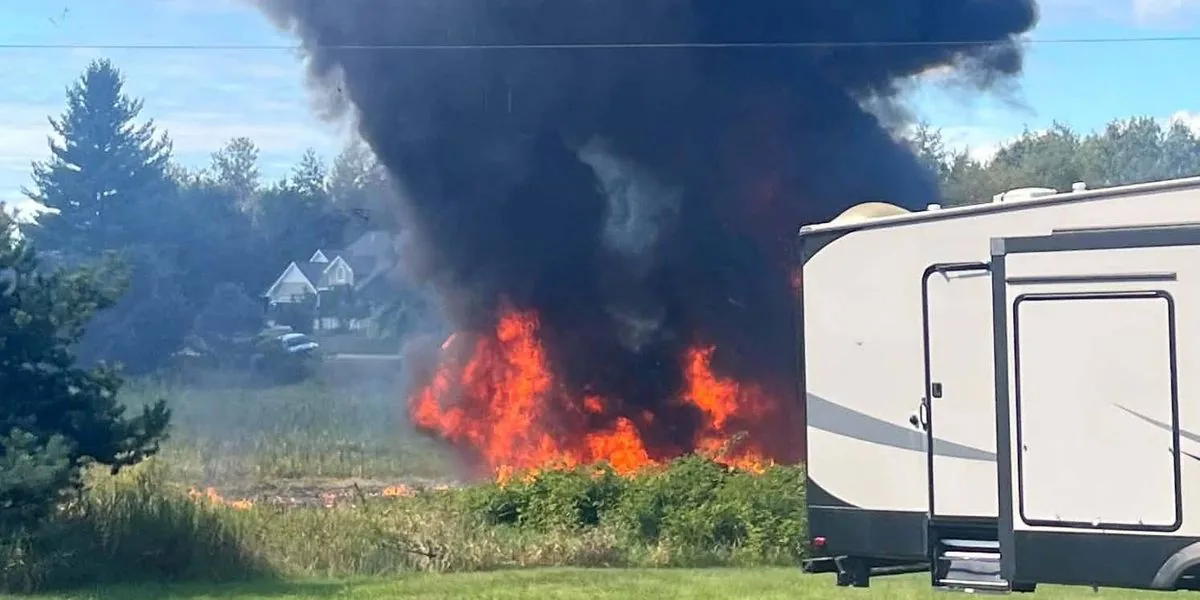
People living and working near the crash site described hearing a loud impact and seeing black smoke rising from a field. Nathan Smith, who was working at a construction site about a mile away, said he began filming the jet because its low and slow flight path looked unusual.
Smith said he heard a loud bang moments later, which he now believes may have been the pilot ejecting. Wendy Sobeck said she and her husband heard what sounded like a very loud crash and saw smoke before her husband drove toward the scene to check what had happened.
Fred Sobeck said he saw a big fireball in the field near a house and camper, though neither structure was hit. He said police told him to get out of the area because explosions were still happening.
Hazardous spill triggered shelter order and one-mile evacuation
Emergency officials first told nearby residents to shelter in place, then Michigan State Police ordered people within one mile of the crash site to evacuate because of a hazardous chemical spill linked to the wreckage. State police did not immediately detail the substance involved.
The concern is significant because F-16 aircraft use hydrazine, a toxic chemical used as part of the emergency power unit fuel system. Officials did not say on Thursday whether hydrazine was confirmed in the spill, only that hazardous chemicals had been released.
By Thursday evening, Grand Traverse County Emergency Management said the evacuation order had been lifted and residents were allowed to return home.
The pilot was treated at a hospital and remained alert
Military officials said the pilot was taken to a local hospital after ejecting from the jet. Gutierrez said the pilot’s condition and identity could not be discussed in detail because of military policy.
Sheriff Shea later said the pilot was conscious and talking with law enforcement while receiving care. That account suggested the ejection was successful and allowed responders to focus on the crash area and the people living nearby.
The military has not said how long the pilot had been in training that day or what led to the emergency. Officials said they would release more information when it is approved.
F-16 safety record draws fresh attention after another crash
The F-16 has been in military service since 1979, and the Air Force Safety Center says there have been at least 14 Class A mishaps involving the aircraft since 2000. That category is generally reserved for the most serious incidents, including cases where damage totals more than $2 million, an aircraft is destroyed or a service member is killed.
The Michigan crash also comes months after an F-16C Fighting Falcon from the Air Force Thunderbirds demonstration squadron crashed in the Southern California desert in December. In that incident, the pilot also ejected safely.
For residents in Grand Traverse County, Thursday’s emergency was a reminder of how quickly a training flight can turn into a local safety response, even when the pilot escapes without immediate life-threatening harm.