


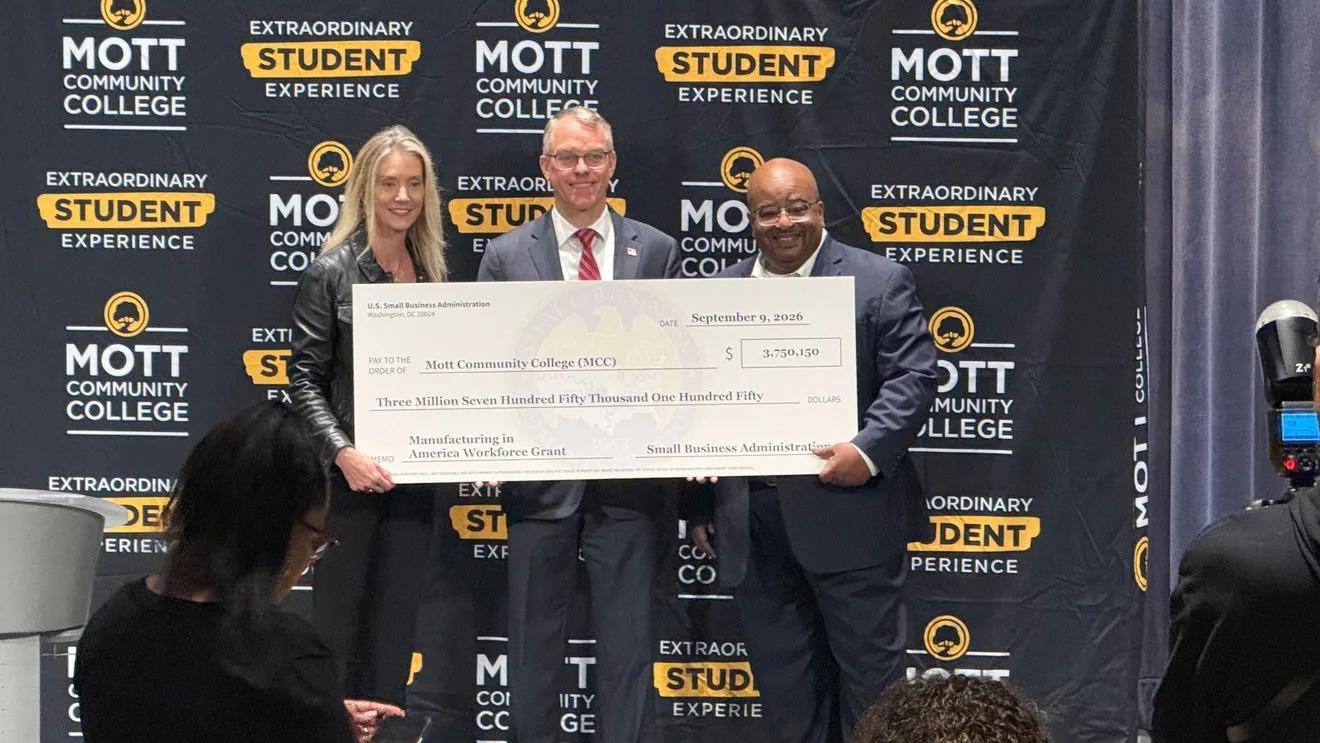
FLINT, MI — Mott Community College has landed a federal grant worth $3,750,150 to expand training for workers tied to regional manufacturers and help address vacant skilled trade jobs across the area.
The money comes from the U.S. Small Business Administration and is part of a broader effort to strengthen the pipeline of workers entering technical and manufacturing careers. College leaders say the funding will help connect students and jobseekers with employers that need trained talent.
President Shaunda Richardson-Snell called the award a major opportunity to build stronger ties with regional manufacturers while continuing to prepare the workforce Michigan needs.
Training planned in welding, robotics and other technical fields
The grant will support instruction in welding, robotics, CNC machining, CDL, information technology and public works. Those areas reflect the range of skills employers often need in manufacturing and related industries.
By focusing on these job-ready fields, Mott Community College aims to prepare workers for positions that are already open or expected to open soon. The school’s goal is not only classroom training but also a direct connection to regional industry needs.
That approach could matter for students looking for a quicker path into stable work, as well as for employers trying to fill positions that require specialized hands-on knowledge. The college is positioning itself as a local training hub for those needs.
Federal funding is part of SBA’s Manufacturing in America initiative
Mott was one of 11 organizations selected for the SBA’s Manufacturing in America E2G Grant Initiative. The award places the Flint college among a small group of recipients chosen to support workforce development in manufacturing.
The program is designed to back training efforts that help businesses find qualified workers. For communities with active industrial bases, grants like this can play a practical role in keeping employers supplied with the labor they need.
For Mott, the federal support gives the college added resources to expand its reach beyond traditional academics and into workforce preparation. The funding also signals that Washington sees local manufacturing training as an important investment.
College leaders say the grant strengthens ties with employers
Richardson-Snell said the award offers an extraordinary chance to deepen relationships with regional manufacturers. Those connections are important because the training only has value if it matches the real needs of employers in the area.
That means the college will likely be working closely with businesses to make sure its programs reflect current technology and industry expectations. Welding and CNC machining, for example, remain central skills in many production settings, while robotics and information technology are increasingly important in modern plants.
The college’s role is to provide a bridge between education and employment, giving workers a clearer route into fields where demand is still strong. For local manufacturers, the payoff could be a more reliable workforce pipeline.
A response to vacant skilled trade jobs across the region
The funding is intended to help fill vacant skilled trade jobs across the region, an issue that can affect productivity and growth for manufacturers. When companies cannot find trained workers, projects can slow and expansion plans can become harder to carry out.
Programs like this are meant to reduce that gap by preparing residents for jobs that may not require a four-year degree but do require specialized training. That can make the opportunity accessible to more people while also meeting employer demand.
In practical terms, the grant gives Mott Community College a chance to serve both sides of the regional labor market. Workers gain a path into technical careers, and businesses gain a potential source of qualified applicants.
What the grant could mean for students and local industry
For students, the announcement points to expanded access to training in fields with clear job prospects. For employers, it suggests a stronger effort to build a workforce that can handle manufacturing, logistics and public works demands.
Although the grant amount is sizable, its long-term impact will depend on how well the college puts the money to work and how many workers complete the training. The immediate takeaway is that Mott now has federal backing to help address a local labor need.
The award also reinforces the college’s place in Flint’s broader economic picture. By training workers for hard-to-fill jobs, Mott is helping connect education with the region’s manufacturing base.