
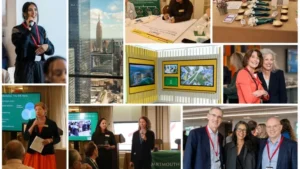

HANOVER, NH — Dartmouth brought its largest delegation yet to Climate Week NYC last month, staging seven events that drew more than 800 registrants and connected scholars, nonprofit leaders, industry executives and policymakers. The programming was designed to show how the university is approaching climate work from several angles at once, including local resilience, energy justice, Arctic knowledge and the financing needed for new infrastructure.
University leaders said the week was intended to make the case that solving climate problems requires cooperation well beyond campus. The events were organized by the Dartmouth Climate Collaborative with help from the Sustainability Office, the Institute of Arctic Studies and the Arthur L. Irving Institute for Energy and Society.
Community resilience and energy justice took center stage
The week opened Sept. 22 with a hands-on workshop for local leaders from government and nonprofit groups, followed by a panel on community-based energy transitions. Moderated by Sarah Kelly, who leads Dartmouth’s Energy Justice Clinic, the discussion brought together Jasmine Graham of Mid-Hudson Energy Transition and Mark James of Vermont Law and Graduate School.
Panelists focused on what energy justice means in practice, not just in theory. They described the pillars of a community-centered transition and compared two solar efforts: one that reduced participants’ electric bills by about 20% and is expected to send more than $1 million back to a community resiliency fund, and another in which subscribers waited more than a year to see savings.
That second program lost momentum as frustration and distrust grew, eventually forcing organizers to pause new enrollments. The contrast, speakers said, showed how quickly confidence can erode when promised benefits do not arrive on time.
Students used Climate Week for their first showcase in New York
After the community-focused session, Dartmouth students took part in their first-ever Climate Week NYC showcase. They presented research tied to the Energy Justice Clinic and the Dartmouth as Living Lab initiative, giving the week a stronger student voice and showing how classroom work is being connected to real-world climate questions.
One of the presentations came from Leonela Espinoza Campomanes ’27, who discussed solar feasibility for an Indigenous community in Chile. Her work was grounded in her own experience growing up with unreliable electricity in Peru, adding a personal dimension to the broader discussion of energy access and resilience.
University leaders said the student presentations helped illustrate the range of Dartmouth climate work, from research projects to future career paths. The showcase also expanded the event lineup beyond expert panels by highlighting undergraduate work in front of an audience of climate professionals.
Arctic knowledge and circular-economy ideas shaped a Finland-backed dialogue
On Sept. 23, the Institute of Arctic Studies joined the University of the Arctic and the Consulate General of Finland for an invitation-only dialogue that featured former Finnish President Tarja Halonen as keynote speaker. The session, moderated by IAS Director Melody Brown Burkins, explored how Indigenous knowledge and circular-economy principles can support climate resilience far beyond the Arctic.
The discussion linked regional expertise with broader climate planning. Rather than treating the Arctic as a distant specialty topic, participants framed it as a place where lessons about adaptation, community knowledge and resource use can inform other regions facing climate stress.
The event added an international policy dimension to the week’s programming and showed how Dartmouth is using Climate Week to connect academic research with government and diplomatic audiences.
Irving Institute panels examined the grid, minerals and AI
The Arthur L. Irving Institute for Energy and Society anchored the second half of the week with four panels built around what faculty director Geoffrey Parker called the energy transition’s real pressure points. Those pressure points included grid operations, supply-chain resilience, capital formation and transmission financing.
One session, co-hosted with SAP, paired a discussion of AI and grid intelligence with a panel on critical minerals and energy security. Experts said the electric system was built for one-way power flow, but now must handle distributed energy resources, bidirectional electricity flows, data silos and cybersecurity risk.
The panelists said technology is advancing quickly, but governance, accountability and collaboration need to keep pace. The minerals discussion then turned to a hard reality: the shift to cleaner energy still depends on expanded mining and recycling, which means climate goals must be balanced against the impacts of extraction.
Capital, transmission and public trust were recurring themes
Another Irving Institute session examined the money needed to build the energy system of the future. Moderated by Tuck’s Charlie Donovan, the panel included Parker, Andrew Beebe ’93 and Giulia Siccardo ’12. The group argued that speculative capital and real breakthroughs often arrive together, even if that relationship can be messy.
One speaker pointed to the collapse of Solyndra after a period of heavy investment in so-called Clean Tech 1.0, the 2006 to 2011 era that helped produce the boom-bust cycle sometimes called the “solar coaster.” Over time, that wave of investment helped drive down solar costs dramatically, contributing to a roughly 90% decline and making solar one of the cheapest energy sources in many markets.
A companion panel on transmission financing, moderated by Distinguished Industry Fellow Abigail Ross Hopper ’93, featured former Federal Energy Regulatory Commission Chairman Willie Phillips and leaders from Southern California Edison, Greenbelt Capital Partners and CTC Global. Their message was that the United States has the technology to expand the grid, but needs financing, regulatory alignment and public trust to move fast enough.
Dartmouth framed the week as part of its larger climate role
Parker said the four Irving Institute panels were meant to position Dartmouth as more than a commentator on climate and energy change. He said the goal was to bring the right people into the same room, encourage new research ideas and help point toward durable solutions.
Barbara Will, Dartmouth’s vice provost for academic and international affairs, said the university spent three days presenting programming about the climate future and reinforcing the idea that collaboration inside and outside the institution is essential. Meredith Kelly, faculty director of the Dartmouth Climate Collaborative, said the events showed action on climate in several forms, from supporting local resilience efforts to opening difficult conversations about the opportunities and tradeoffs of the energy transition.
Together, the week’s sessions gave Dartmouth a visible platform in New York while also highlighting student work, alumni careers and partnerships across disciplines. The university said the effort reflected a broader push to connect research, education and practice in climate work.