


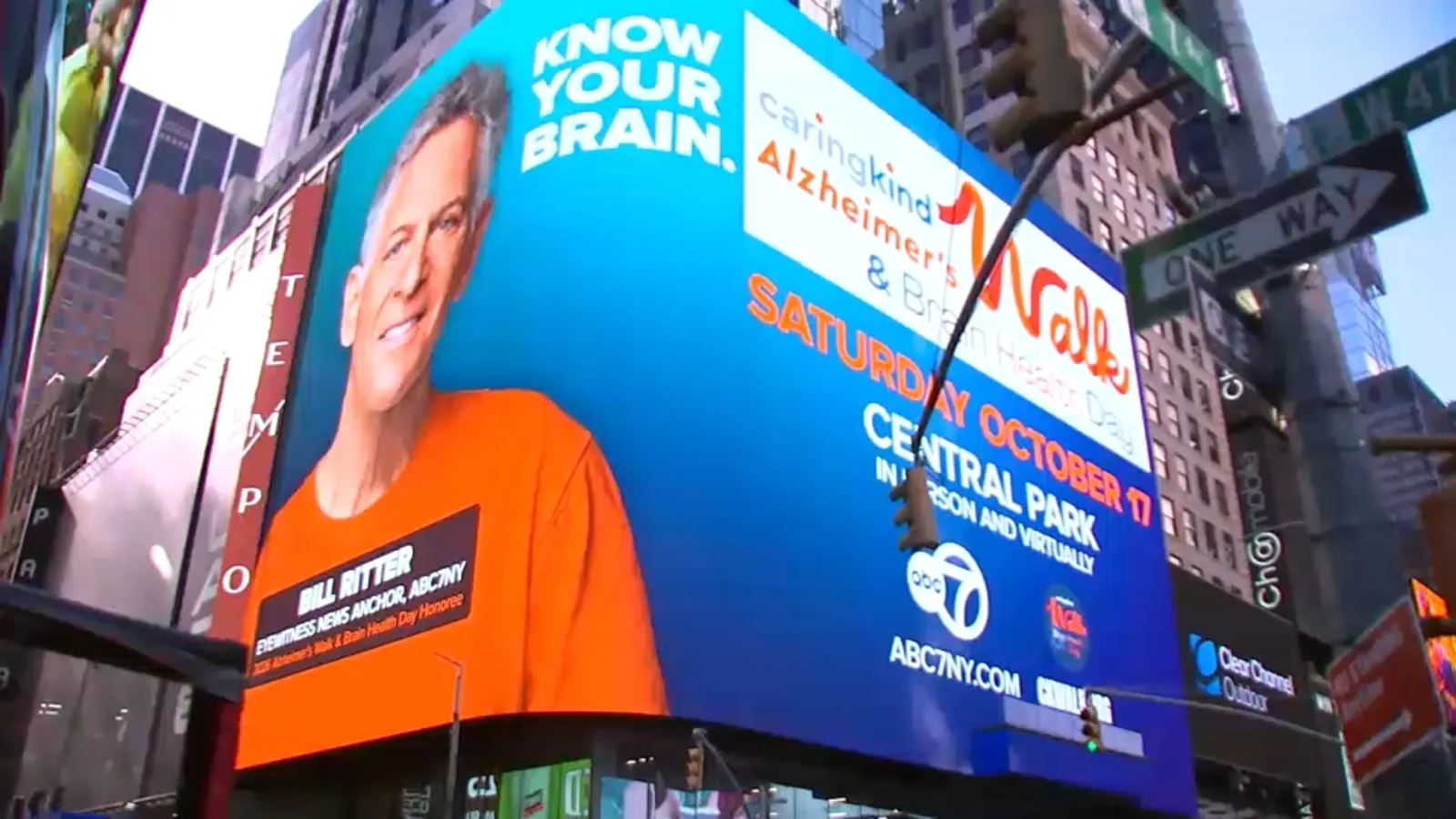
NEW YORK, NY — Bill Ritter received a public salute in Times Square on Friday as CaringKind recognized his work raising awareness about Alzheimer’s disease and brain health. The longtime broadcaster, who has spoken openly about his diagnosis, is now serving as the new face of the caregiving organization’s campaign.
The honor placed Ritter in the middle of one of New York City’s most visible public spaces, underscoring how personal advocacy can reach a wide audience. CaringKind and ABC7 have been working together in recent weeks to bring more attention to brain health, encourage conversations at home, and reduce the stigma that still surrounds the disease.
Ritter says openness can help families facing Alzheimer’s
Ritter said he has heard from many people who have confided that they have told only one or two people about their diagnosis. His message to them is simple: do not isolate yourself.
He said opening up can bring support from others who want to help, listen, and show affection during a difficult time. For Ritter, that kind of human connection matters as much as the public awareness efforts now built around his own experience.
His remarks reflected the broader goal of the campaign: helping people feel less alone and more willing to talk about memory loss, diagnosis, and caregiving needs.
CaringKind says a familiar face can reduce stigma
Eleonora Tornatore-Mikesh, president and CEO of CaringKind, said Ritter’s honesty makes him especially effective as a spokesperson. She described him as someone with a strong sense of truth and a deep connection to the community, especially in New York City.
Tornatore-Mikesh said people need to see someone like Ritter because many others living with the disease may not be ready to share their diagnosis publicly. Seeing a familiar face, she said, can make the condition feel more approachable and less isolating.
She also emphasized that people facing Alzheimer’s and their families need encouragement during what can be a vulnerable and difficult journey.
ABC7 partnership is pushing brain health into everyday conversation
Over the past several weeks, and continuing in the months ahead, Ritter and ABC7 have teamed up with CaringKind on a broader awareness effort. The campaign includes on-air stories, community events, educational resources, and public outreach designed to put brain health in front of more families.
Organizers say the effort is meant to reduce stigma, empower loved ones, and inspire action before the disease becomes even more overwhelming. Rather than treating Alzheimer’s as a topic discussed only in medical settings, the campaign aims to make it part of everyday conversation.
That approach reflects a growing focus on awareness as a first step, alongside support for people who are already dealing with the disease in their own homes.
Central Park walk will feature free brain health pre-screenings
The campaign’s biggest event will come on Saturday, Oct. 17, during CaringKind’s 38th annual Alzheimer’s Walk & Brain Health Day in Central Park. Thousands of participants are expected to gather to walk, learn, and support healthier futures for families affected by the disease.
For the first time, the walk will also offer free brain health pre-screenings. Tornatore-Mikesh said these screenings are not diagnoses, but they can help start a conversation that people can later bring to their doctor.
Organizers say that early conversation matters because it can help families take the next practical step with more information and less fear.
A special Eyewitness News program will focus on research and families
ABC7 also plans a special Eyewitness News program next Thursday at 5:30 p.m. The broadcast will look at the latest research into Alzheimer’s disease and include conversations with families who are caring for loved ones living with it.
That combination of science and personal experience fits the tone of the larger campaign, which is trying to show both the medical challenge and the human reality behind the diagnosis. By pairing research coverage with family stories, the program aims to give viewers practical insight as well as emotional context.
For CaringKind and Ritter, the hope is that more visibility will lead to more understanding, and more understanding will lead to more support.
Billboard tribute turns advocacy into a public message
The Times Square billboard marked a striking public acknowledgment of Ritter’s work, turning a personal diagnosis into a message that can be seen by thousands of passersby. For CaringKind, the display serves as both recognition and outreach.
The campaign’s message is that Alzheimer’s should not be hidden, and that people living with the disease deserve empathy, conversation, and resources. By placing that message in Times Square, organizers are hoping it reaches not only families already touched by the condition, but also people who may one day need the same support.
In a city known for constant motion, the billboard offered a pause for a difficult but important subject.