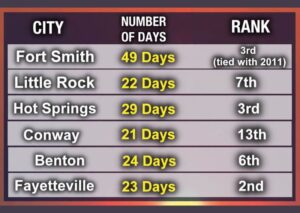
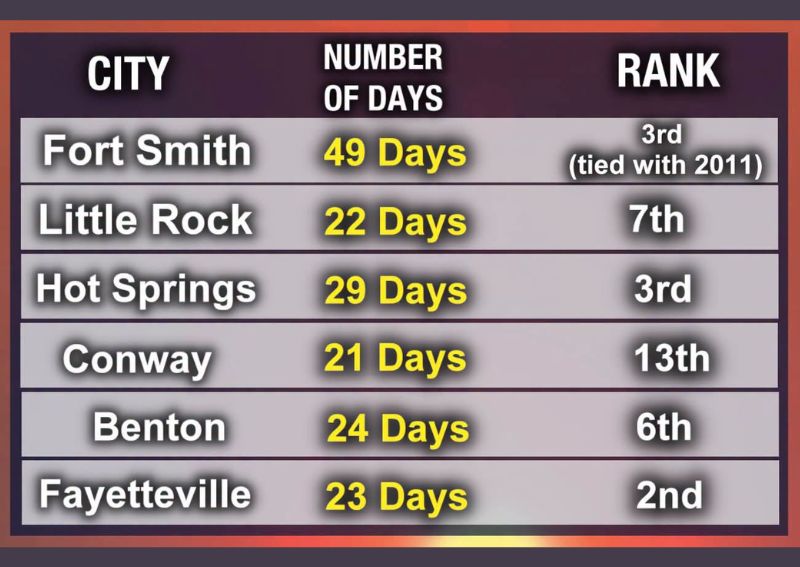
FORT SMITH, AR — Fort Smith has officially closed out one of its hottest summers on record, finishing 2026 with a total of 49 days at 100 degrees or higher, a mark that ties the city with 2011 for the third most 100-degree days ever recorded. The extraordinary total places this summer behind only two other years in Fort Smith’s recorded weather history, underscoring just how relentless the heat proved to be across the region throughout the season.
Only Two Summers in History Were Hotter
Fort Smith’s 49 days of triple-digit heat during the summer of 2026 ranks as the third highest total ever recorded for the city, trailing only the summers of 1932 and 1954, which remain the two hottest summers on record for 100-degree day totals. Tying with 2011, a summer widely remembered across Arkansas and much of the central United States for its extreme and prolonged heat, further emphasizes the historic nature of this year’s stretch of triple-digit conditions.
Reaching this level of sustained extreme heat requires an unusually persistent pattern of high pressure and limited rainfall over an extended period, conditions that clearly characterized much of the 2026 summer season across western Arkansas and the broader Fort Smith metropolitan area.
Statewide Heat Extended Well Beyond Fort Smith
While Fort Smith recorded the most dramatic total among Arkansas cities, the extreme heat of summer 2026 was far from isolated to that single location. Hot Springs finished the season with 29 days at 100 degrees or more, also ranking third all-time for that city, while Fayetteville recorded 23 such days, placing it second in its own local rankings. Benton saw 24 days of triple-digit heat, good for sixth place historically, and Little Rock and Conway rounded out the list with 22 and 21 days respectively.
This widespread pattern of significant triple-digit day totals across multiple Arkansas cities, each ranking among their own historical top tier, confirms that the extreme heat of summer 2026 was a statewide phenomenon rather than a localized anomaly affecting only one or two communities.
A Summer Defined by Persistent Extreme Heat
The sheer scale of triple-digit days recorded across Arkansas this summer paints a clear picture of a season dominated by persistent, extreme heat from beginning to end. When multiple major cities across a state simultaneously post top-ten or top-fifteen all-time rankings for 100-degree days within the same summer, it reflects a broad and sustained high-pressure pattern affecting the entire region rather than isolated pockets of unusually hot weather in specific locations.
Meteorologists tracking these totals note that summers producing this level of consistent extreme heat across so many communities simultaneously are relatively rare, making the 2026 season a notable entry in the historical record for Arkansas heat events.
Looking Ahead With Cautious Optimism
With the summer heat totals now finalized, there is cautious optimism that the worst of the extreme conditions is now behind the region as the calendar moves further into fall. While the historic totals recorded across Fort Smith and other Arkansas cities will remain part of the permanent climate record for these locations, the transition toward cooler, more seasonal conditions offers residents a welcome respite following one of the most persistently hot summers in the state’s recorded history.
Congratulations have poured in for Fort Smith as the city closes the books on a summer that will be remembered for generations, joining the exclusive company of 1932, 1954, and 1911 among the hottest summers the city has ever endured. Local weather trackers note that reaching this kind of historic ranking requires not just occasional spikes of extreme heat, but a sustained pattern of triple-digit conditions repeating day after day across a significant portion of the summer months.
The comparison to the summer of 2011 carries particular significance for longtime Arkansas residents, as that summer remains a benchmark for extreme heat across the state and much of the surrounding region. Tying that historic total in 2026 places this year’s summer squarely among the most memorable and challenging heat events in recent Arkansas history, a distinction that will likely be referenced by meteorologists and residents alike for years to come whenever comparing future hot summers against the historical record for Fort Smith and the broader region.
For continuing coverage of severe weather events and critical storm analysis across the United States, visit diamondprowl.com.