

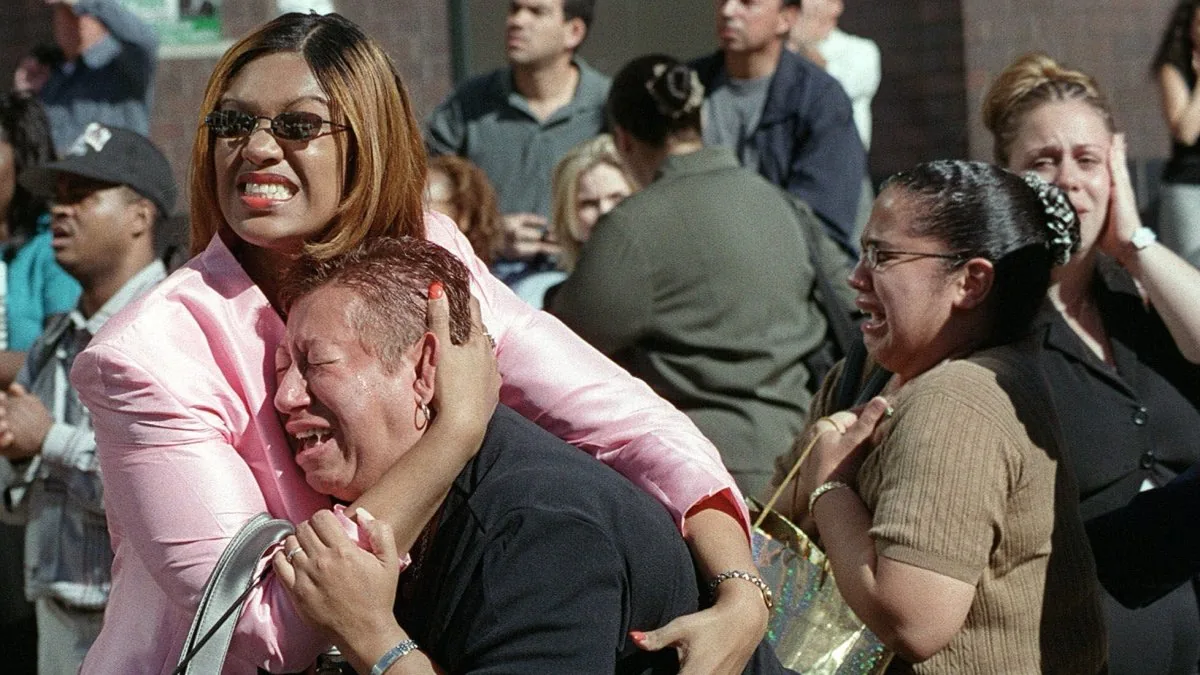
NEW YORK, NY — Twenty-five years after the Sept. 11 attacks, the shock still reaches beyond the sites where the planes hit and the buildings fell. The grief spread across the country then, and its meaning has continued to shift as Americans have lived through new losses, new security rules and new national events.
What feels fixed to one generation can feel distant or historical to another. For people who were old enough to remember the attacks, 9/11 may still mark a clear before and after. For younger Americans, it is something learned in school, shaped by family stories, public memorials and the world they inherited after 2001.
How the attacks reshaped daily life and national security
The attacks helped usher in a post-9/11 world defined by airport screening, tighter security and greater surveillance. Those changes have become ordinary parts of American life, even as they reflect the fear and uncertainty that followed the attacks.
Experts quoted by NBC New York said the response also changed institutions. The Department of Homeland Security was created, the Transportation Security Administration became a permanent presence in travel, and immigration enforcement hardened in the years that followed. Those shifts were not only about immediate safety; they also reflected a broader reordering of government and public life.
Jayesh Rathod, a Georgetown Law professor, said the idea of an outside threat tied to appearance or origin helped fuel that reorganization. He said the country’s security mindset has since become deeply normalized.
Families carried the losses in different ways
The piece also shows how 9/11 continues to live differently inside individual families. Jenna McPartland, a chef and restaurant owner in Fairfield, Connecticut, was expecting her first child when her husband, Ariel Jacobs, was killed at the World Trade Center.
She gave birth days later to their son, Gabriel, whose life was altered by an event he never experienced himself. McPartland later remarried twice, had two younger sons and became a stepmother to two teenagers. Even as her family changed, she made sure her children knew that Sept. 11 remained part of their family history.
McPartland said her children understand the day in different ways. One of her sons wrote a college essay about being part of a 9/11 family without being the “9/11 kid,” a reminder that the attacks shaped not only the people who died but the lives built after them.
Muslim, Sikh and Middle Eastern communities faced new suspicion
In the years after the attacks, fear and suspicion often landed on Muslim Americans and others perceived as connected to Muslim-majority regions. That pressure came on top of existing racism and stereotypes already present in the United States.
The story points to the federal National Security Entry-Exit Registration System, created in 2002, which required non-U.S. citizen males over 16 from 25 countries, almost all of them Muslim-majority, to register at certain ports of entry or at immigration offices if they were already in the country. Critics condemned the program as profiling, and it was later dismantled.
It also recalls the killing of Balbir Singh Sodhi, a Sikh gas station owner in Arizona who was shot four days after the attacks because his assailant wrongly believed he was Arab. The case underscored how quickly prejudice could turn violent in the tense atmosphere after Sept. 11.
A younger generation knows 9/11 through family stories and school lessons
For Americans born after 2001, 9/11 has always been a historical event rather than a personal memory. They may know the basics from classrooms, museums and family conversations, but they did not live through the era when people could meet loved ones at airport gates or when the attacks divided the country into a vivid before and after.
Vida Lashgari, a 21-year-old raised in California, said her family background helped her understand how the attacks affected Middle Easterners, Sikhs and other brown communities. Her mother is Mexican and her father is Persian, and she said she learned early that many people became more aware of how they looked, dressed and spoke after 9/11.
Lashgari said that fear stayed with many in those communities. For younger people like her, the attacks are part of inherited memory as much as lived experience.
The pandemic gave some young Americans a new reference point for upheaval
Some of that distance changed again during the COVID-19 pandemic. Lashgari said the pandemic gave her a clearer sense of what it means for daily life to change overnight and for people to lose control over events around them.
She said COVID-19 was the closest she has felt to the kind of sudden disruption older Americans associate with 9/11. That comparison did not erase the attacks’ significance, but it gave her generation a different way to understand how a single event can reorder a society.
The piece suggests that national memory is always moving. As new crises arrive, earlier ones do not vanish, but they do take up less space in daily conversation and public thought.
Memorials help preserve meaning as history keeps changing
Amy Sodaro, a sociology professor at Borough of Manhattan Community College who studies memorials and museums, said that changing historical memory is one reason people create places of remembrance. She said she once believed 9/11 would define the rest of her life and the society around her.
Over time, though, other geopolitical events and major shifts changed how the attacks are remembered both individually and collectively. The meaning of 9/11 has not disappeared, but it now sits beside later events that also shaped American life.
That layering of grief, politics, security and family memory is what makes the anniversary feel different 25 years later. The attacks remain a national wound, but the way Americans understand that wound has grown more varied with time.